My colony is queenless….or is it?
I love nature…but what does that mean?
I immerse myself in the outdoors around where I live; this is a world that constantly changes, but to many; the casual observer, it looks, sounds and smells the same as ever. There’s enough wild life around for me to notice subtle daily changes in it. I have learnt to ‘see’ this part of the world. I see small changes in the nature around me as I walk my usual walks, I’m constantly looking for things to ‘see’. As a result, I’m sure I see much more than anyone else who walks around here for an occasional walk.
A little philosophical maybe, but the moral of this point about ‘seeing’ is by no means new and has been used throughout time. I could walk around the same area with a completely different mindset and ‘see’ very little nature because I not looking for it, I’m on this walk for other reasons…A friend once said, ‘always take a different walk’. And I can see their point. If I do this I will see different things every time, and of course, I do take different walks.
But, by taking the same or similar walks around the countryside where I live, I learn so much about the subtle changes, when trees and flowers bloom, in what order, how each year differs from the next…..not to mention different sounds and smells, the way the brook changes depending on weather, and then in spring the hedgerows bursting into flower, almost suddenly overgrown.
For me, this is what beekeeping is all about; getting close to the nature of the honeybee. Walking around the local countryside is about observing nature; ‘seeing’ things that only a few will notice. This closeness to nature is the essence of beekeeping.
Finding the queen is always a challenge for the beginner and indeed experienced beekeeper alike. Marking the queen helps no end particularly when/if the colony gets big, but also helpful when the queen goes off-lay for some reason. Inspecting a bee hive is about learning to look and see what’s happening. Reading the hive. Being able to see eggs is important, but tricky even for me on some occasions. I have reading glasses specifically for beekeeping, giving me a focal length of about 30-50cm so that I can see the bee combs in fine detail.
The classic place to find the queen as the colony builds up in Spring is on the frame(s) with eggs and open larvae as she is more than likely laying eggs. She will more than likely be moving slowly around the frame, but of course, she doesn’t like the light and so can be a little elusive running to the edge and onto the opposite side that you’re looking at. This is why it’s important to keep the frame above the hive, just in case she drops off. Last season I foolishly lost two beautiful looking queens, one was a large supercedure queen that was about to lay. And there’s the issue ‘about to lay’. As I went to catch her for marking, she flew and never returned. Arghh too impatient. A young queen can often fly, so it’s best to let them get laying and come back a week or so later when she is well established. The second was a queen in a mating nuc in full lay, and again as I went to catch her to mark, she was running away back and forth from one side of the frame to the other and then she dropped and I never found her again.
So the colony is growing well in Spring, you’re making notes about frames of sealed and unsealed brood as well as stores, all looking great until the next time when there are queen cells and you cannot find her…
Of course, the colony is doing what it loves to do; swarm. You on the other hand don’t want to lose the queen and half the bees. Is she still there? There’s a saying that if the QCs are sealed then the likelihood is that the swarm has gone, but not necessarily. Are there eggs visible? The next thing to look for as it shows that the queen has been here recently and maybe she still is…Then you can start to isolate frames as you look for her. You can split boxes if the colony is on brood and a half or double brood. Take the top box and put it away from the main hive and wait for 20-30 mins. When you come back are the bees in either of these two boxes making a louder noise than the other? This is the noise of the ‘queenless’ colony and you’ll get used to it as you tune yourself into the nature of the hive. The bees only make this noise when they first realise that she has gone missing, so if the bees in one of your two boxes is making this noise, you know that the queen is still here and in the other box where the bees are quite happy going about their business. If on the other hand, both boxes are still ‘happy’, then you’re none the wiser.
I’ve often heard beekeepers say; ‘there are too many bees for them to have swarmed’. Well, the bees plan the swarm in fine detail, they ensure that as the queen leaves with half the colony’s bees the half remaining also has many bees about to emerge. If the bees emerging from one frame of sealed brood can cover three frames then very quickly the hive looks full. Something else to become aware of as you tune yourself into the nature of the hive. On the flip side the bees can do the exact opposite and swarm out, sending cast after cast leaving behind a small colony. I’m talking about that time when you think to yourself, ‘there are too many bees here, they can’t have swarmed’.
Later in the season, the June gap maybe, the forage has slowed down and the bees react to this by also slowing down. The queen goes off lay and depending on how long there is a lack of forage the colony can become broodless. If the queen isn’t laying the worker bees stop feeding her royal jelly, she has to feed herself sometimes. As a result, she slims down and can be anywhere in the hive often on her own. I often get calls from beekeepers at this time saying the hive is queenless, can they have a queen? Of course they can, but I will say to them, please be very sure that your hive is queenless as the bees will simply kill the new queen when you introduce her. I would say that half of the time I get a call back saying that the queen has been found. It can be a nerve-racking time, as the queen, if unmarked and the same colour/marking as the workers can hide away very effectively.
I keep an observation hive as a mating hive and last year I had a ‘barren’ queen; a queen that looked as though she went out to mate, but never actually started to lay. When she emerged from her QC she was serenaded by young worker bees. Older worker bees started to frantically forage for pollen; they would return to the hive and dance on the frames to the other bees, often brushing past the queen as if telling her to get ready to go and mate. Then five or six days after she had emerged she left the hive and I had to presume that she got mated. The worker bees would energetically polish the cells for her to lay; she would inspect them carefully head down, then she would position her abdomen into the cell as if to lay an egg, pulling out triumphantly for workers to inspect her work, only to find that there was nothing there. All the while the foraging bees were bringing in pollen and packing it into cells around a ‘laying area’ of polished cells ready for the queen to lay in. A month passed, end of June, still no eggs, the queen continued to practise laying. Then, one day in mid-July, the queen seemed to have disappeared. Hmm. I put a queen cell in the top of the hive and the workers got quite excited. Then I spotted the queen, she was still there, looking small, but still there. By this time the colony was starting to dwindle, but never a sign of the bees removing the queen, or indeed of laying eggs themselves. The workers continued to forage. From the outside, bees would be seen taking pollen in. A barren queen is tolerated and her presence stops workers from laying eggs. I had seen another example of a barren queen in a colony coming out of winter. I’d marked the queen so that when I was ready I could easily replace her. She was differently marked/coloured to the workers and so easier to spot. Also in this colony, the workers tolerated her and didn’t lay eggs themselves, even though she wasn’t doing so. In the observation hive, the queen was very hard to spot even in this small colony (unmarked). The bees rejected the queen cell that I’d given them. Now both of these barren queens had been produced by the emergency process. As I’ve only seen these two barren queens in my beekeeping life I cannot say for absolute certain that that is the reason that they’re barren, but it gives food for thought. Jay Smith the great queen rearer of 100 or so years ago talks about small queens that are so difficult to find, in his books on queen rearing. By far the best books I’ve read on the subject, in contrast to all those who say throw out the old books! Ha! Such poor advice. Listen to ‘experts’, take what works for you, but don’t follow blindly…
This leads me onto the introduction of a new queen into a seemingly queenless colony. I rear queens and make up nucs. On most occassions, the queen is accepted. I’ll take two frames, at least one with emerging brood and young bees. I’ll leave them for a few days, check to see that they haven’t made QCs, and break them down if they have. With my experience of ‘barren’ queens, I’ll make sure that this nuc has some larvae in which to make a QC, because if they don’t take advantage of these then I may have a small queen hiding in there. If I’m happy that they’re HOPELESSLY QUEENLESS, I’ll introduce a new queen in a cage, firstly on top of the frames to gauge the bees’ reaction to her. If they’re keen, I’ll place the cage between the frames and let the bees eat the candy to release her.
I bought a queen to rear queens from and introduced her into a nuc. Six days later she was still in the cage, the candy had been eaten. I put her onto the face of a frame and the bees tried to ball her so I picked her up and put her into a smaller nuc where she was accepted. I continued to monitor the first nuc and a week later there were young larvae. They had a queen! Albeit a small queen of the same colouring as the workers. Now in this example, the queen came into lay, but suppose they had a barren queen, small and the same colouring as the worker bees? Such that she is almost impossible to see! I would have to test using a frame of eggs or in reality two or three cells with a young larva grafted into it. If they make a QC I know that they’re queenless, if not, then they have a queen even if I can’t find her!! What to do? Well, I could do the same as if I had laying workers. That is shake all the bees out onto the grass some distance away and hope that the queen/laying workers don’t make it back to the hive. Then test again with young larvae. Armed with this ‘eggs test’ or ‘larvae test’, I quite often get asked for a frame of eggs. Well, these are valuable and I can’t keep taking frames out of colonies. That’s why I now ‘graft’ two or three larvae and use them as a test.
It is so easy to jump to the conclusion that the colony is queenless, it’s also very easy to get a new queen killed because there is still a queen there and she and/or the workers kill the new queen. We are also all too aware that if there really isn’t a queen in the hive and the colony has been broodless and queenless for a few days or more, the workers may start laying eggs and that is a difficult situation to rectify.
A queen can hide very well, they like the edges of frames where they pop between the two sides, and they can also stay still on a frame with workers covering her. Another way to find the queen is to shake the bees through a queen excluder. Put a QE above a brood box with frames, then another on top and shake all bees into the upper box. Use smoke to persuade them down through the QE. If there is a queen she’ll be walking about on the QE.
Having an observation hive lets me see the working of the hive on a daily basis without too much disruption. It is fascinating to watch the behaviours of the bees as the season moves on. Compared to the weekly inspection when we ‘crack’ open the hive and disrupt the nest and its operation, put it back together again for the bees to spend days repairing the damage until next time depending on the extent of the inspection. On reflection, I was disappointed when the queen didn’t lay, but it was a great learning experience. I also witnessed the making of the pollen ‘arc’ around the empty nest space. I guess that I assumed that the queen laid eggs and the bees did their best to put the pollen on the periphery of the brood nest. Having watched this small colony, I feel that the bees make a calculation based on the colony size. Cells are polished ready for laying and pollen is stored directly next to these polished cells.
It is important to observe the bee’s activity from outside the hive to give us some idea of what’s going on. Bees taking pollen into the hive is always a very satisfying thing to watch. Pollen is used mainly to feed young larvae, so if we see it going in on the hind legs of the worker bee, then there is in all likelihood a brood nest with larvae being fed. Most of the time the larvae have hatched from eggs laid by a fertile queen. However, there are other situations when young larvae are present and being fed, those of the infertile queen or ‘drone layer’ and those of laying workers. We also see that the mere presence of a queen is enough to encourage workers to forage for pollen even if the queen isn’t laying eggs fertile or infertile! Food for thought.
The observation hive:
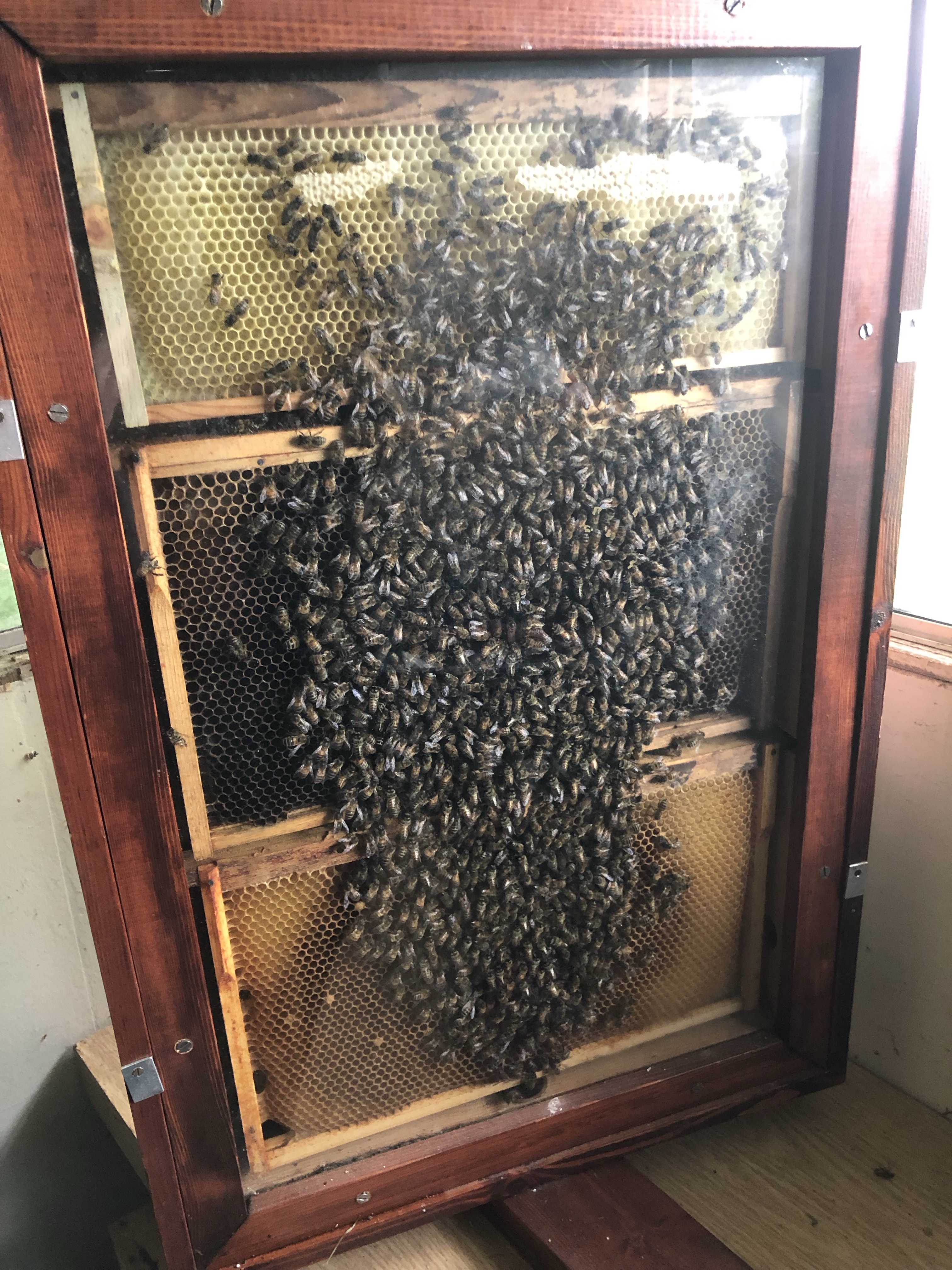
The Barren Queen:

 The Mountain
wow!! 37The Life of a Breconshire Beekeeper January 2024